

BOTRY-Zen®
The Biological Solution for Botrytis, Sclerotinia, and Pseudomonas syringae pv actinidiae (Psa)
The active ingredient is derived directly from nature. Each gram contains not less than 2.5 × 10⁸ colony-forming units (cfu) of Ulocladium oudemansii strain U3, formulated as a water-dispersible granule.
BOTRY-Zen® is registered under the ACVM Act 1997, Registration No. P7212.
Certified as an organic input by BioGro.
Registered by the EPA.
-
BOTRY-Zen® is a certified organic biological control agent developed for the suppression of Botrytis cinerea in grapes, blackcurrants, kiwifruit, and ornamental flowers, as well as Sclerotinia sclerotiorum in kiwifruit. It is certified by BioGro, listed with OMRI (USA), and recognized by IFOAM (International).
The active ingredient, Ulocladium oudemansii strain U3, is a naturally occurring saprophytic fungus that colonizes dead and decaying plant material. This ecological behavior makes it ideal for occupying the same niches targeted by Botrytis and Sclerotinia, effectively outcompeting these pathogens at sites of early disease development.
BOTRY-Zen® is non-invasive and does not harm living plant tissue. Due to its competitive mode of action, the risk of resistance development is extremely low. For enhanced efficacy, especially in late-season applications (post-flowering), it is recommended to mix BOTRY-Zen® with a seaweed-based product such as those produced by AgriSea, which provides nutrients that support rapid fungal establishment on plant surfaces.
-
BOTRY-Zen® is applied through standard spray equipment. As with any spray application, coverage and timing are vital in obtaining a good result. BOTRY-Zen® can be tank-mixed with a number of fungicides, refer to the list of compatible products or contact our technical team for further information.
Following approval for the use of BOTRY-Zen against Psa (now Fully Proven) applications are recommended from bud-burst to fruit-set, and then again after harvest and after pruning.
Best Practice
Trials
BOTRY-Zen® has been trialed in New Zealand since 1997 in wine grapes, kiwifruit, blackcurrants and ornamentals. Trials in wine grapes have also been conducted in the United States, France, Germany, Greece, Slovakia and Spain. The results of these trials show that when BOTRY-Zen® is applied correctly, it provides protection against Botrytis/Sclerotinia infections comparable to a standard fungicide programme.
BOTRY-Zen® has recently been included in the product testing program conducted by Kiwi Vine Health (KVH) as part of ongoing efforts to manage Pseudomonas syringae pv. actinidiae (Psa). In trials conducted under high-infection pressure, plants treated with BOTRY-Zen® showed a significant reduction in Psa-related leaf spotting just 15 days after application—highlighting its strong potential as a biocontrol agent.
Following promising results from previous field trials, Botryzen (2010) Ltd applied in October 2013 to update the product registration to include a Limited Claim for Psa – Not Fully Proven. This status was officially granted by the Agricultural Compounds and Veterinary Medicines (ACVM) group.
In May 2014, BOTRY-Zen® was formally included in the KVH/ Zespri spray charts for Post-Harvest use in kiwifruit orchards. According to the official product recommendation:
“Apply post-harvest through dormancy. Should not be applied when fruit is on the vines, as it can cause staining. Certified BioGro Status. This product is available for Psa-V control on orchards that have completed harvest.”
BOTRY-Zen® continues to gain recognition as a valuable tool in integrated Psa management programs, offering growers a sustainable and certified organic solution.
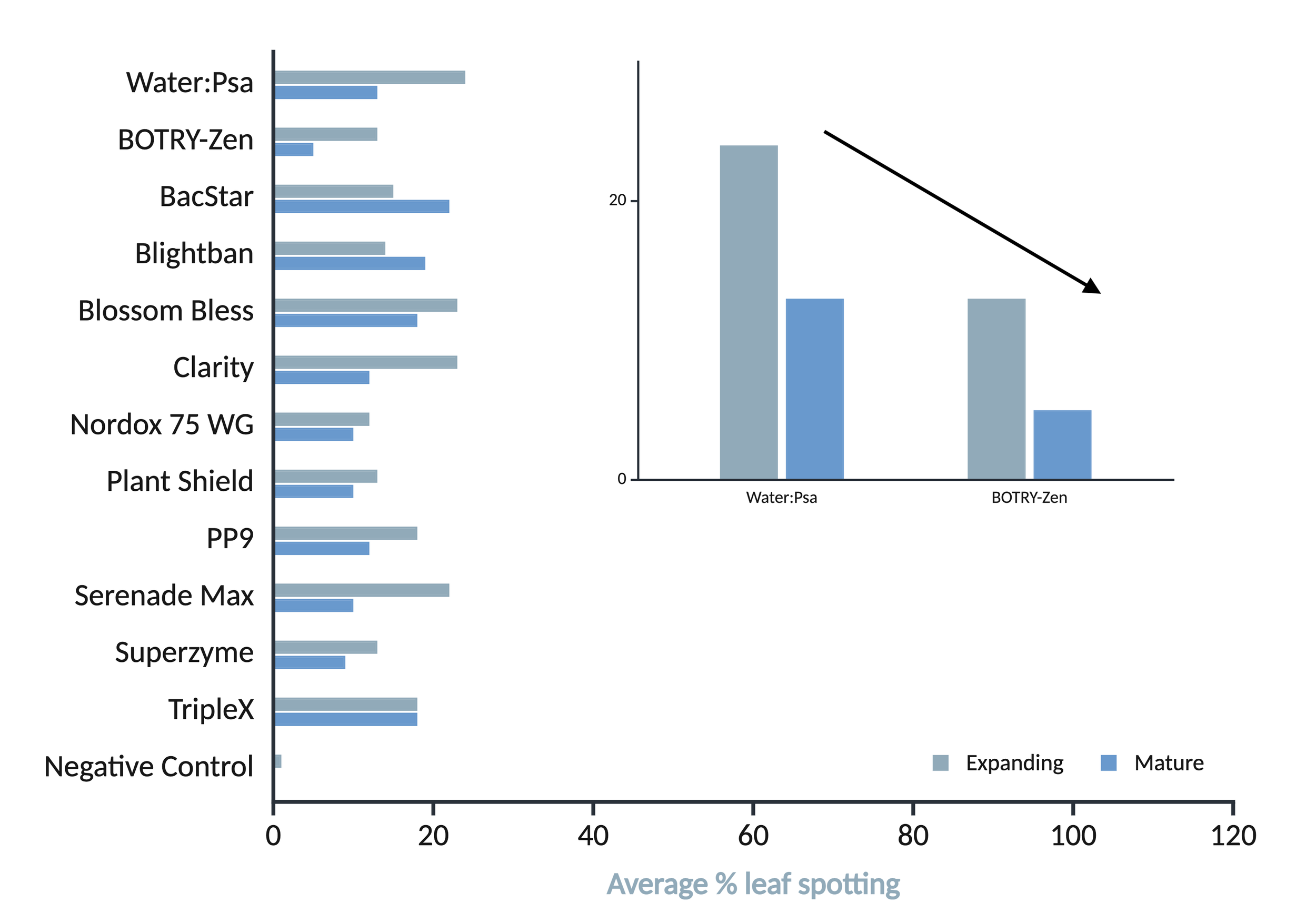
Kiwifruit Study
A 2020/21 field trial showed that a tank mix of BOTRY-Zen® + Timorex® Gold, applied at 80–90% flowering, provided comparable protection to Luna Privilege against Sclerotinia in Hayward kiwifruit, reducing both fruitlet infections and scarring.

